
I would like to share with you my thoughts about the reality of conservation and especially around this event, which is the birth of four cheetah cubs in the reserve.
I was fortunate to get an internship in a program dedicated to wildlife conservation.
In the reserve where we operate, the wildlife conservation actions include:
- Monitoring and obtaining visuals on all collared species in the reserve, sometimes twice a day, which is the most important activity of all.
- Identifying the need for veterinary intervention in case an animal gets injured, especially by snares.
- Identifying individuals and creating an ID kit based on volunteer photos or camera traps.
- Removing snares and collaborating with anti-poaching teams.
- Removing invasive alien plant species.
- Processing camera trap data.
Since the birth of the cheetah cubs, we have also added cheetah sitting to the list of activities.
One of the rangers is an expert in cheetahs. He is so passionate about them that it was unquestionable this event would receive the full support of the team.
To protect the female cheetah and her cubs, we initiated 24/7 monitoring, braving high temperatures, mosquitoes, ticks, predators, and sometimes rain and thunderstorms.

Why did we start close monitoring?
Cheetahs are a vulnerable species, probably critically endangered but not recognized as such. Only 6,500 individuals remain worldwide. Their reproduction rate is very low, except in South Africa, where it can reach an 8% success rate.
It is very important that this new litter survives to contribute to the species’ survival by introducing new genetics into different reserves or countries.
Cheetah cubs are like kittens. Cheetahs have altricial litters, with cubs that can’t open their eyes, thermoregulate, or move themselves in the first weeks. They are completely helpless and exclusively dependent on their mother for survival. Cheetahs face numerous predators as they are at the base of the predator food chain (leopards, lions, hyenas, etc.), including humans. But not only: since the cubs are small and helpless, even smaller predators like raptors, honey badgers, and jackals can pose a threat.
Currently, the drought is severe, and we barely had any rain. The water levels are diminishing daily.
The area that the female cheetah prefers for her den is near the community fence. This area has no waterholes nearby, and as a result,very little prey.
When the female cheetah hunts for hours, leaving her litter hidden but defenseless against predators, it becomes a major concern.
- The Risk to the Mother: She moves through an area where we’ve found many snares. While our team has removed all visible snares, more could appear, especially as year-end celebrations approach and the community seeks more bushmeat. If she gets caught in a snare, she could die within 15–20 minutes, leaving the cubs orphaned.
- The Risk to the Cubs: At this age, the cubs are extremely vulnerable, and prolonged absences by their mother increase the chances of predation.
Feeding the Female Cheetah
To support the mother and ensure she doesn’t have to hunt for long periods, we’ve provided impala carcasses. This is a delicate process because cheetahs only eat fresh meat and refuse anything that has been previously frozen.
With temperatures reaching 40°C, keeping meat fresh is a challenge. And should she make a kill herself, our attempts become useless. We ended up finding a solution by making sure the meat is never frozen while keeping it as fresh as possible in this hot weather. We store the carcass in the freezer during the day and leave it outside during the night. With this process, she now accepts the impala meat we provide.
Nothing is wasted in this process, even if it hasn’t been eaten by the cheetah, the carcass is used for other purposes and nothing is wasted in the process. It will be brought to our bait site for the injured and snared hyenas.
My initial thoughts were to require no intervention and let nature follow its process.
I was uncomfortable with us sacrificing an impala for a cheetah. The impalas are not endangered, and have a very successful reproduction process, which consists of dropping all the newborns at the same time. With this approach, some get killed by predators, but a great part of the nursery survives.
I am not sure killing an animal for the survival of another made sense.
However, there are compelling arguments for intervention.
The cheetah species is critically endangered, and every effort to ensure the survival of these cubs contributes to their conservation.
If we didn’t provide food, the cheetah would hunt for sure. It would take her more or less time. All the time she spent away is endangering the small cheetah cubs. And given the area she has chosen for the den, she will have to be away for extended periods.
Keeping the mother well-fed also ensures the survival of the cubs.
Another consideration is that water is not necessary as long as she eats; she can survive up to 40 days without drinking. The water source comes from the meat she ingurgitates. If she eats properly, she will be able to lactate properly.
Despite my reservations, I now see the necessity of this approach and even feel satisfaction when she accepts the meat we provide.
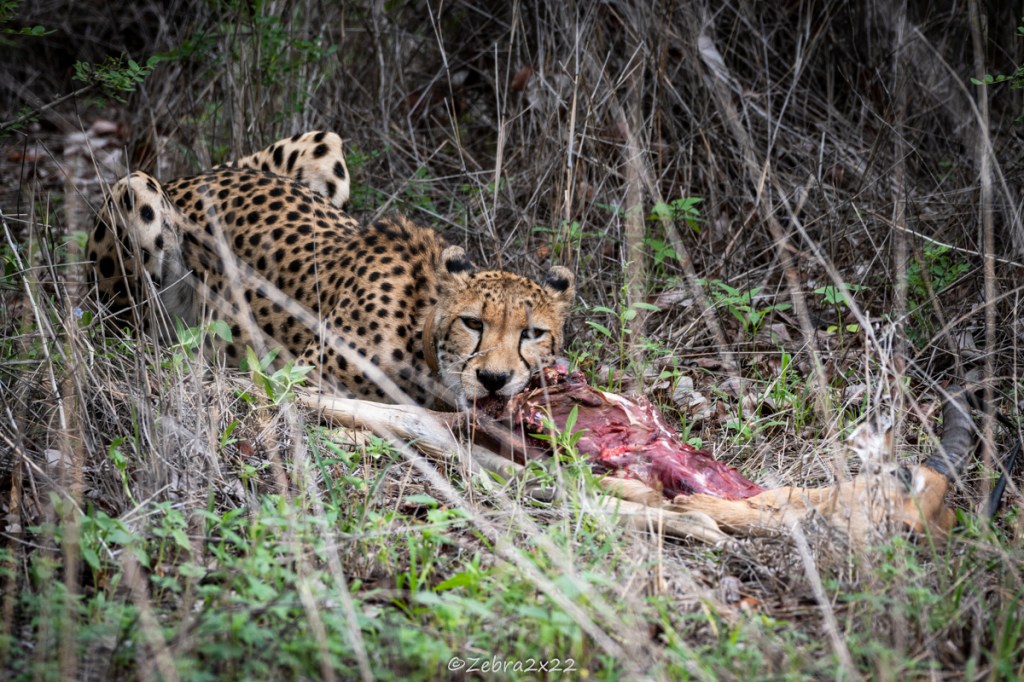
Feeding her requires strategic planning to ensure the safety of the cubs. We need to make sure she eats far away from the den to avoid attracting leopards and scavengers to the area. This requires luring her outside of the den, presenting her with the meat, and driving far from the den with her following the bike.
Another method consists of waiting for her to move outside of the den, finding her, and providing the meat in the area where she is hunting. Crossing fingers, she hasn’t killed something in the meantime.
So far, the feeding process has been successful. During our monitoring, we observe she is hungry, and needs to eat a lot.
It is impressive to see how quickly she learns. We have been feeding her with the motorbike : one person holding the carcass and the other driving. We use this process so that she can pursue us and get her meat far from the den. Once, we knew she was hunting but couldn’t find her while driving along the fence. We continued searching for her along the fence, but she found us, and we could give her the meat right away. Somehow, she has associated the noise of the motorbike with our attempts to feed her. That shows how clever cheetahs can be.
By adding a whistle to our approach, we’ve further reinforced this association, although she still takes her time deciding.

Other interventions
The list of our interventions doesn’t stop here.
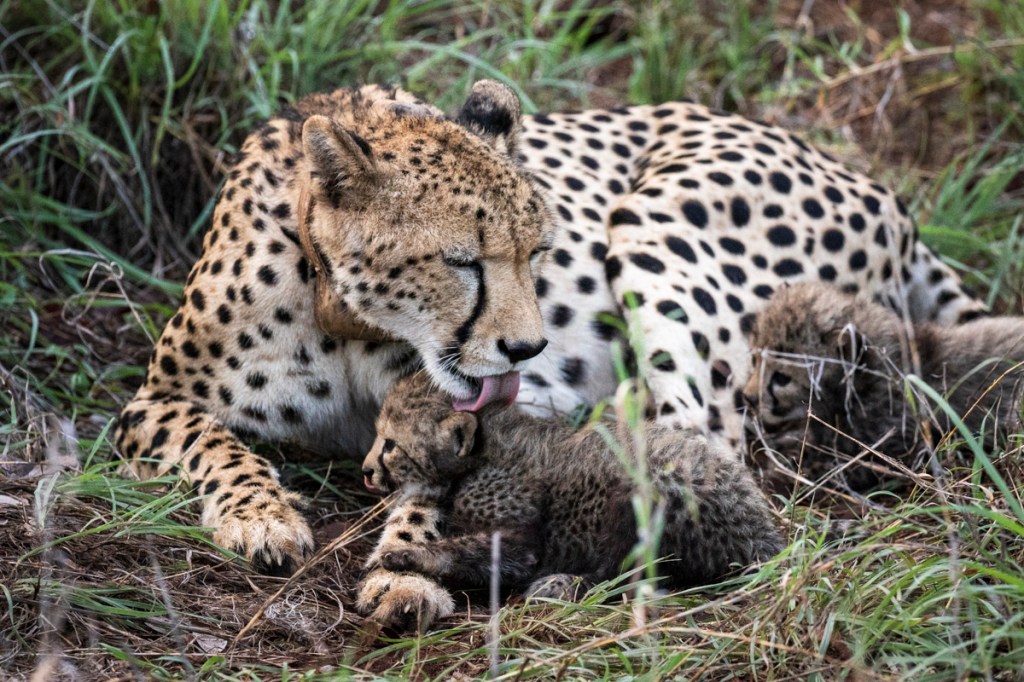
Once, she had been away for quite some time. It was in the early beginning when the cubs couldn’t move. The den location was not ideal. While the sun was performing its rotation, the cubs got very exposed to heat. They started calling their mother and drawing attention to them. They could also be dying of dehydration. Our ranger moved them to a shady area. They stopped calling, they were not exposed anymore, and fell asleep. It is probably the one and only mistake the female cheetah has made as a mother since the beginning, but it could be corrected easily. She had no problem finding them again, licked them as if nothing happened. It really is a myth to say that animals will abandon their litter if it has been touched or approached by humans. We could intervene without jeopardizing their existence. It is important to highlight that this was a one-off; our aim is absolutely to avoid getting close, making sure they have the space they need, and obviously avoiding touching them at all costs. However, this act probably saved their existence as the female cheetah left them for quite a while that day.
Another intervention, and probably one of the aims of our monitoring, amongst gathering data and observing how the female cheetah is rearing the cubs, is to ward off predators. While I was showing the den at night to one of my colleagues and we were approaching it, he mentioned that he could see her with the thermal. I was a bit confused that she was away from the den and in the dense bush. I thought she might have moved while I was fetching my colleague. He tried to identify her using the telemetry, but she was at the exact same location as the den. The cat was a leopard. My colleague scared it away. That night, it came back around 3 o’clock, and my colleague scared it away again.
We need to be able to face all the scenarios.
- What if a dog is coming towards the den? Instructions are to shoot it. For several reasons. They are very good hunters, and they could also be poachers’ dogs.
- What if lions are coming? The idea will be to use the car and try to scare them off with it. If it doesn’t work, we may bring the cubs inside the car for protection.
- What if the buffaloes are coming? Same with the car. They are not a direct predator of cheetahs, but they could trample them to death without noticing it.
- What if a leopard is coming? The idea is to go in its direction, shout, wave, and try to scare it away.
And loads of scenarios may be happening even and especially the ones we haven’t foreseen.
Challenges of Human Intervention
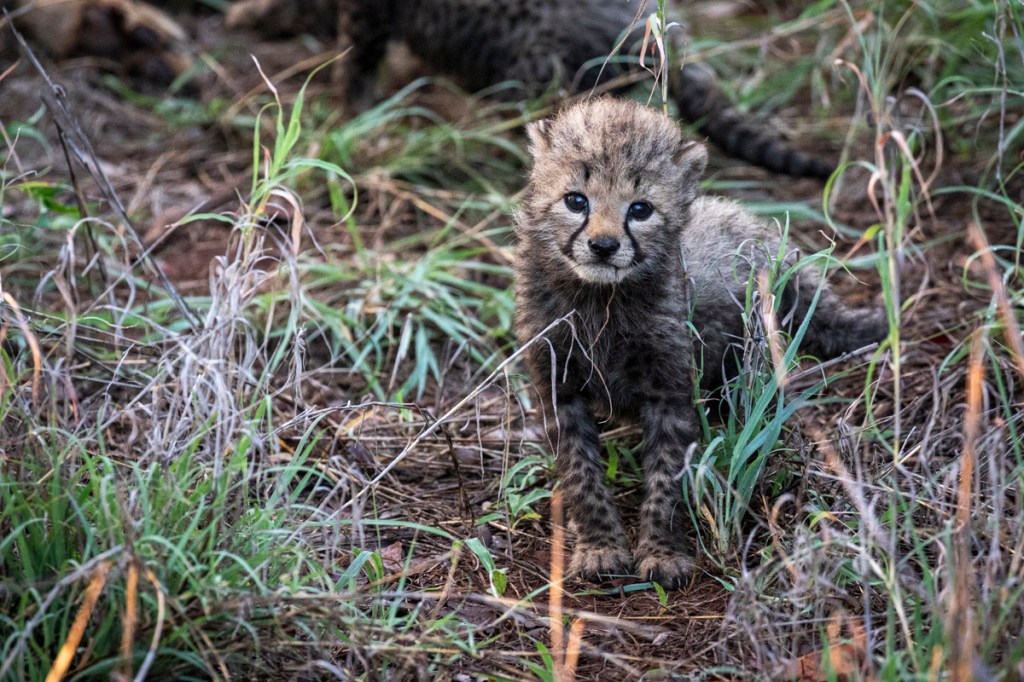
Our monitoring inevitably exposes the cubs to humans early in their lives. This early exposure may prevent them from associating humans with fear, which might be a problem, especially when considering threats like poaching or interactions with local communities. I discussed this with our expert, and he explained that one of the main consequences is that these cheetahs can only be relocated to fenced reserves to mitigate human conflict. However, their behavior towards other humans may vary, and we’ll be closely monitoring this in the coming weeks, hoping for a positive outcome.
First conclusions
Conserving endangered species requires deep consideration and the careful balancing of multiple factors. It’s far more complex than it might seem at first glance, and every decision made carries consequences. This internship has truly shown me how crucial it is to approach wildlife conservation with seriousness and mindfulness. Engaging with experts and discussing our actions provides invaluable insights, helping me understand the bigger picture in ways I never could have otherwise. I feel incredibly privileged to have been given this opportunity to contribute to such meaningful work.

 Zebra2x22
Leave a comment